Wednesday, August 25, 2010

Everythingness

Back when I was a Barbie, before I had children and became the anti-Barbie, I sometimes thought about the twenty-somethings I'd have someday and what I would and wouldn’t do, all based of course on what I was doing at the time. That’s what makes Barbies, Barbies - a view of the future that looks suspiciously the present, but after a diet. In the Barbie years, we make many decisions about the future, usually while applying make-up to our own twenty-something faces which we can’t imagine looking like any-something else.

But - and I knew this even when I was buying knee high boots and running out of Adorn hair spray - I would not be a Mom Barbie who wore Daughter Barbie’s clothes, had facelifts, flirted with younger men, used teenage language or did other gross things to win approval that would make her Child Barbies cringe. Because - and I knew this even when I was reading Dear Abby in traffic jams and making my hair wider than my body and affecting Faye Dunaway’s “Network” expression in meetings - Barbie years have a shelf life.

Since I like to stay ahead of the curve I’ve implored my children, friends and hairstylist to help me remain true to that pledge. I’ve stopped my daughters to the point of annoying them to ask about my outfit: “Okay or too young?” My hairstylist always begins our sessions (and they are sessions with the hairstylist, they are not appointments) with the question: “So. What are we doing today?” Once, in response, I suggested that “we” just color my hair gray now and get it over with. In the mirror, behind me, she tilted her head, raised her little hairstylist tools like the magic wands that they are and said, “Um. I’m not liking that idea.”

But shelf life, schmelf life. Barbie years do not have to screech to a halt and morph into Meredith-from-The Office years. No, if done right they can evolve into elegant, earthy, Everything years when the work on the inside is done but for decorative touches, and we can throw ourselves into being as Christine would say, “who we are.” By then, we've put away our plastic heels, we're using less (but expensive) make-up, buying way fewer hair products, wearing the seat belt every single time, and can’t remember the last time we went to McDonald’s (that’s a lie, I went two weeks ago this Friday for a Big Mac because I felt like it). We dress for our lifestyles as much as appearance, we work out because it feels good to be strong, we read novels that stay with us for days, and take ourselves out for lunch because we find our own company agreeable and interesting. We do stuff selectively. See the friends who love us, think about where we haven’t been and go there – even if alone. We love our younger, Barbie-esque friends, but don’t care if they approve of us. We nurture our inner cheerleaders and keep their little flags in good working order so that the words on them, which say “Why not?” and “Life is short,” can be viewed as needed.

I went ziplining with two of my Everything friends last week.


My sons would have considered it mild compared to the roller coasters they’ve been on but for me, as my world goes, if only for a few paralyzing seconds:

it was death-defying. Afterward, my Everything friends and I ate pizza, drank wine and talked about, of course, Everythingness. I believe I loved that as much as I once loved a great black dress and four inch heels.

Barbie years look great. But the Everything years, these are for the Serious.

Saturday, August 21, 2010

Clothespin doll


In three weeks, I have had three discussions with three mothers who are all at some precipice or another with regard to their growing children. One whose young child is entering the “K-3”years, one whose child will enter high school this fall, another whose last child will leave for college in a week. These discussions have the same question at the core:

What now?

I don't want this to be the blog of get-to-the-point, (see preceding post) but I think the parenting career (I refuse to call it a journey. Everybody calls everything a journey) is as fascinating as the period that follows childbirth itself when, without even paying extra, we get to marinate in the new knowledge that we are super-powerful after all, capable of all things in the entire world, because just look at what we produced, even as we were coming apart like a clothespin doll. And men, if they aren’t the obstetricians, reinforce this. I don’t care how many times they wince at Mel Gibson being stretched to death on a rack, crowning wins. Witnessing the birth of our four children changed the way my husband looked at me forever.

That’s how we feel on day one of our parenting career. Blessed, and cursed with the knowledge that we can do anything for our children if we have to, want to, need to, if that’s what they need, even if it hurts.

But I don’t want this to be the blog of I-already-know-that so I’ll move on.

More than once in my twenty-four year parenting career I’ve woken at 3 a.m. with two thoughts: I don’t know what she’s doing. And, what if she needs me? Then the what-ifs start. What if she didn’t lock her door? What if he walked home from a party and got mugged? What if she’s too sick to call and tell me she’s sick? What if he needs me, but he’s too proud to tell me he needs help? What if he needs me? What if she needs me? And so on.

Nobody imagines the worst like a mother can. Mothers imagine things so horrible they won’t even share them with other mothers (even though they should). It’s irrational, but it keeps us on our toes anticipating all that disaster and ways to prevent it. But the question isn’t really about the child’s welfare, because at 3:20 while we’re trying to control our breathing and slow our minds, our child is actually updating her status on Facebook and listening to something on Grooveshark. No, the question is really about a mother’s reach and correlationally, how well the child can possibly be doing if we aren’t involved with it somehow. It’s more than good parenting to wonder, it’s who we are and what we’ve done since our entry-level parenting years when our involvement did determine how well our children did. We told them what to do, what to eat, when, where, how and all the rest, and at that point in their little child careers, they thrived with all that supervision.

And so did we because after all, we didn’t almost split in half for nothing.

But it flips without warning. At some point, it’s time for them to drive, and time for us to shut up when they bump the curb because if we don’t, we’re not advancing them in their child careers, we’re telling them they’re not ready and they will believe us. It flips when they don’t share what they think, when they struggle but won’t ask for help, when they grow quiet and dark and stay in their rooms for too-long stretches while we wait on the other side, preparing a good ice-breaker which, God willing, will lead to a meaningful conversation like we used to have. And then, just as we’re considering the worst (drugs, of course) and talking it over with all our friends, and reading “life with your teenager” articles, it flips anew when from out of nowhere our child asks us to go for lunch, or shows us what they bought at the mall, or tells us something that has the potential to make us unhappy because, somewhere, somehow, holed up in there with only their own minds for company, they found the legs that go with their opinions.

It should feel good when they weather these storm systems in their child careers and emerge stronger and smarter, even if we lose weight and can’t focus on a television commercial while it’s happening, because it means we’re all being promoted. But I can go on forever about “should” now that my daughters and I cry at the same movies and have conversations that start with “So, listen to this.” When it was happening, what it felt like was, “what now?”

Eventually, if we stop telling and start asking, our children tell us “what.” Then they become CEO of their child careers, and we become trusted consultants. This is when we coach, more than we supervise (right, Kris?). This is when they call us not for advice, but support. Not for directions, but guidance. Not to hear the words of worry in our hearts, but the love in our voices.

So if you feel lost in the haze of “what now?” it might help to picture this: you’re ten or twenty years from now, sitting in a restaurant with your son or daughter who has, by now, become Chairchild of the Board. You say this: What was the thing you needed most from me when you were (their age now). They will tell you. If you’re watching and listening, you actually know the answer right now. Be that clothespin doll again, even if it hurts.


And now, I will think of a reason to go boss my fifteen-year-old around, because very soon, he’ll have his license and he will be driving. And I will be a passenger, looking for opportunities to shut up.

Thursday, August 19, 2010

Rejection. There's no game without it.


I was rejected recently by a publication which until now has accepted everything I’ve submitted. That it happened two weeks before I plan to submit a novel to at least a hundred agents in NYC is coincidental. But timing feels like fate. I’ve silenced it, I’ve sent it back to its corner, but that insidious little voice has crept into my forehead more than once to say, “See? I told you.”

Certain uncomfortable truths emerge in the course of writing and submitting even as they argue with each other. Here are two: Some writers publish, but all writers get rejected. And, all writers (even bad ones) get better with more writing. We need both. We need to know we’re as wonderful as our mothers said we were, and we need to get over ourselves once that happens. Acceptance is the bouncer at the door taking a quick look and waving you on. Rejection, at least in the first few hours of its life, is the person at the party glancing past your ear for someone more interesting to talk to.

And here is the third truth: if it doesn’t collapse a writer’s hopes altogether, rejection fuels improvement. Rejection separates the hopeful from the Serious.

So there are two ways to handle rejection. One is to respect the opinion of that insidious little voice and feel that at least you’ve smartened up before wasting any more time. The other is pick up that insidious little voice and flush it down the toilet like a daddy long legs.

Two weeks.
A hundred agents.
There will be rejection.

Game on.

Wednesday, August 11, 2010

Zero Balance

Every so often, I become fretful about people I love who are beyond my short reach. When that happens, I look skyward. I lack formal religion – my God looks like King Triton in The Little Mermaid – but our arrangement is like those that others have with their Gods: God looks out for someone I love and I offer something in exchange that is reasonable. Like letting everyone go in traffic for the rest of the day, or paying a stranger a compliment that’s sincere.

Last year, God helped me wait out my mother’s sudden, serious surgery. God helped me make a move that overwhelmed me. God kept an eye on three of my children while they lived in the city. In our longest collaboration to date, God helped me cut back the scrub around my marriage so that I could see the heart and soul of it with new eyes.

I can’t say my payments have been all that regular and so I wasn’t surprised when God came to the door last week to collect.

I was closing up shop – keys in hand, bag over shoulder, sunglasses on. I tried not to notice my co-worker who was involved in a printer jam that was making quick waste of her day-long project. Because I had plans. So I called out, “See you tomorrow," but elbow deep in printer guts she didn’t respond.


Now would be a good time, said God.


So,“Can I do anything to help you before I go?” I asked.
“Actually,” she said, and she handed me a stack of overnight express mail which had to be registered at the post office in person. “If you wouldn’t mind stopping…” She looked like she was going to cry.

Sincere, God reminded me.
“Not at all,” I said, “Happy to do it.”

The post office at 4:45 is like this:
And I was only there at 4:45 because I’d been held up in twenty-five minutes of summer construction traffic. Prepare for delays, said the signs and then it started to rain.

When I entered the post office (soaked because I had no umbrella), the line was seven deep. At the end of it stood a teenager holding a huge bag, and a stuffed animal in her hand. She wore a T-shirt that had some sort of cartoon figure across the front and pajama pants. She looked at me with a startled expression.

“Are you in line?” I asked.
“No, go ahead,” she said, “I just have to ask a question.”

Heads up, God said.

I accepted her offer and took her place in line.
When I turned, she was staring at me.
“I just have to ask a question,” she repeated.
“What’s your question?” I asked.
“Well, I started making these,” she said, raising the doll. “I’m trying to find out how to ship them.”
I nodded, but I was thinking about the line which had come to a halt.
With nothing else to do, I turned again and said, “How do you market them?”
“I have a website,” she said. “I have someone in Connecticut who wants one.”
Then, she reached into her bag. “Do you want to see the others?”

Prepare for delays.

“Sure,” I said.

She showed me three models, all perfectly crafted, in soft colors with impeccable, brightly colored stitching. They had the kind of appeal that everything homemade has in this freezer-to-table age of substitutes. Something your grandmother would make but with a teenager’s half-hopeful touch. Sincerely, I said, “I would have bought one for my child when they were small. These are really sweet.”
“I have to put a heart on this one,” she said, showing me the doll. “It goes on the outside.”

The line didn’t move for another five minutes. I wondered if there were more staff outside smoking. Then another person entered the post office and another, and each time, the girl surrendered her spot.

“Are you nervous about asking the questions?” I asked.
“Kind of.”
“Well, tell me,” I said.

It was simple. She’d put her enterprise together on the internet, researched and learned what she needed to know there, and managed to start production without actually speaking to another person. When it came time to interact, present her work, maybe defend her idea, well, it was easier to let people take her place in line. I could imagine the effect a negative postal worker could have, with only a single, sloppy word of discouragement.

“You go ahead of me,” I said.
“Are you sure?”
“Yes. Just ask, how would I ship twenty of these to someone in Connecticut?”

She took my spot. Something broke and we moved ahead. She was called to the counter and so was I. I looked over and saw an older woman talking to her, nodding, smiling, fingering one of the dolls and complimenting her work. When the woman began to describe some shipping process, the girl reached into her bag and took out a spiral notebook and pen with a gargoyle on the end. Very seriously, she wrote down the instructions.

On the way to my car, I noticed the rain had stopped and the traffic had cleared but no wonder. I had been in that post office for nearly a half hour. But I believe that girl went home and started another project. And I have a zero balance again.

Sunday, August 1, 2010

Why nice people buy pepper spray


It’s a bad thing for everyone when someone craves a feeling of power over their lives and can’t get it. It’s bad for the people who scan their groceries, for their children, for their co-workers, for their pets, and for people behind them on 89.

I’m reasonable in this respect. If someone hunkers down in the left lane doing that passive aggressive 55 mph thing (and it is intentional - you can see them checking the rear view mirror as though to assess their faux power over happy people) I wait and cut out when there’s a chance, then go back over, and coast along until someone comes along who’s in a bigger hurry. Then out I go and back I come, like it’s a happy highway ballet because I like that left lane. It’s zippy and more fun.

But I was one of the twelve or thirteen cars behind such a power-challenged type the other day. While the right lane trudged, clogged with traffic, a red van drove 56 mph in the left lane, eagerly checking out the white SUV in his rear-view mirror who drifted on his tail, wild with frustration. Weaving to the left and right, I thought the white SUV might actually pass on the left. Had there been a sudden stop by the red van, both he and the SUV would have involved more than themselves in a serious wreck.

Suddenly there was a break on the right and the white SUV darted out. With a gust of speed he passed the driver on the left who came unglued. Arms waving, head moving around, screaming, he railed at the SUV, now waaaay up the road. I could see his face in his own mirror, red, twisted.

Now I was behind him in place of the white SUV, but only politely close because traffic was heavy. Too close for him, however. He caught sight of me behind him, and jumped into the right lane. When I pulled alongside him he was like a crazy ape, raging inside a cage. We approached a light, I in the left lane, he on the right and he lowered his window. Pointing at me, he began screaming:
“Hey! Asshole! You’re an asshole!”
I ignored him.
He got louder. “Asshole! You! ASSHOLE!!”

The light took forever, but finally, he got his green arrow and made a right hand turn. Then he took a right into a nearby lot, screeched to a halt, and got out of his car. I said a very bad word and locked my doors. He pointed in my direction, still ranting. Boxed in, I looked at the median to my left and thought about driving over it should this psycho head my way. Then the light turned and I rushed away before anything else happened.

I got to work and sat in my chair looking at the same screen for twenty minutes before I could answer even easy questions.

It’s a bad thing for everyone when someone craves a feeling of power over their lives and can’t get it. It’s bad for the people who scan their groceries, for their children, for their co-workers, for their pets, and for people who have to use their highway to go to work.

With all my heart, I hope this man’s next confrontation is with a person who deals with his type all the time and knows how to put him in his place – like a cop.

Friday, July 30, 2010

Writer-cat


Writer-cats don't just sit around looking good. They teach you things.

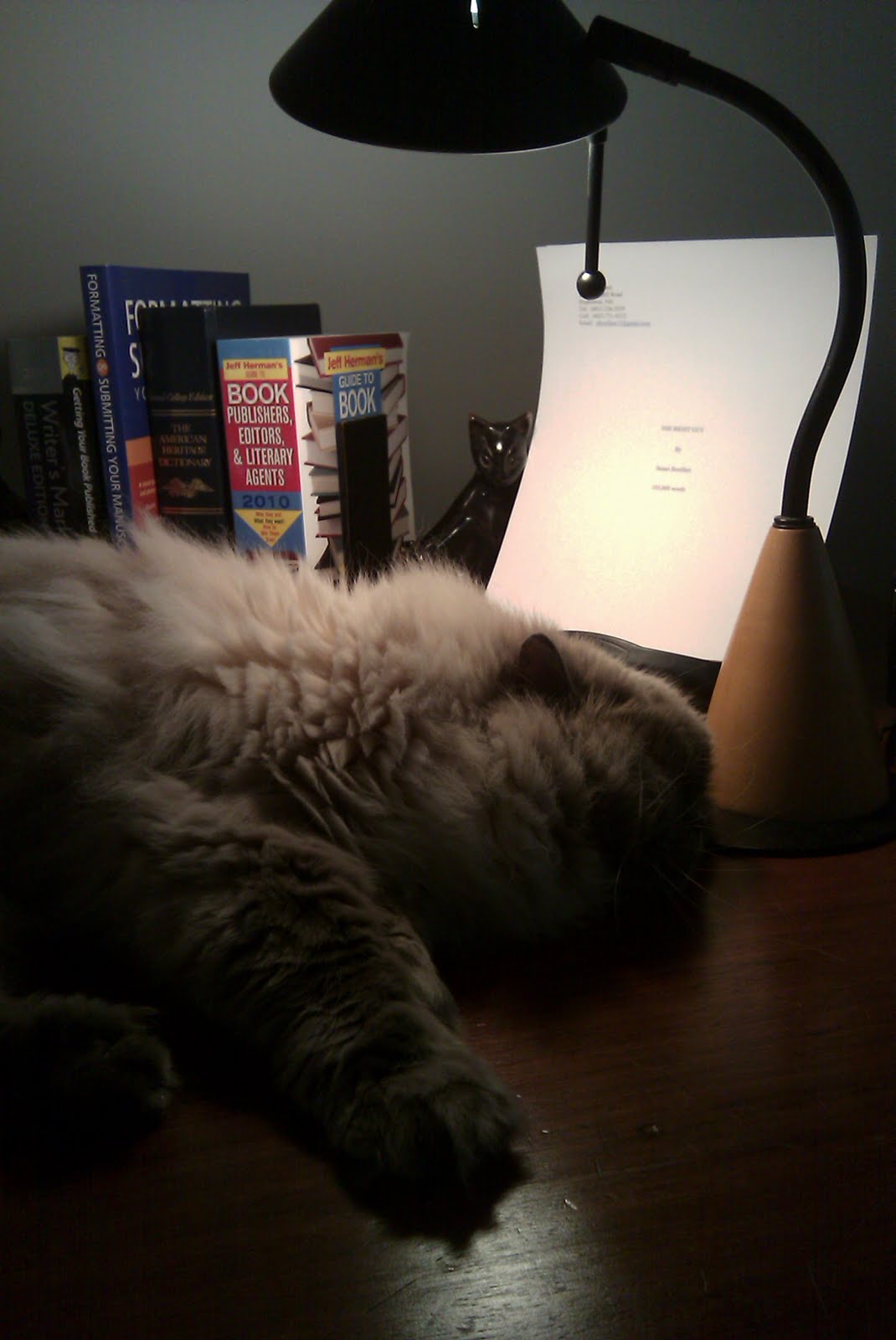
I got my writer-cat Percy on my fortieth birthday, a Himalayan who looked like a tiny lion in the palm of my hand, elegant, even then. He grew up to become a dog-cat...loyal, present, sweet, never out of sight. In my former attic, he napped next to a lamp while I wrote, re-wrote, re-wrote again, and finally finished my novel, The Right Guy. When I went downstairs for a break he followed, descending the stairs like a slinky. When I stopped to answer the phone or read the mail, he had a seat until we were ready to return to the attic where I'd go back to the page and he'd resume his nap. Writer-cats nap 22 hours a day. They have to, because that's how much time writers spend thinking about their novels.
The move to our new house was probably tough on him with the dismantling of old routines and the adjustment to new ones. But worse for Percy was a daunting spiral staircase that leads to the loft where I now write. Steep, with tight turns and open between the steps to the ground below, the staircase is challenging to the most nimble beings, but with my encouragement he gave it a shot - a little hop and then, bunched around his four paws, tiny turns until he was facing the next step. Another hop, more turns. And that's where he quit. For whatever the reason, less agility or fear of height, he wouldn't do more. He settled for waiting on the bottom step while I worked above, finishing, refinishing, and re-re-finishing my finished novel. I put an out-basket next to the lamp, big enough for a manuscript.

Two weeks later, while I worked on finishing the novel anew, I heard a small, unfamiliar sound. I turned and sitting there, at the top of the stairs, was Percy. It probably took him the entire time I'd been there, or maybe he worked on it during his two wakeful hours. But there he was, on the job. I called him over and praised him for being brave. Then I moved the out-basket and like a writer-kitten, he hopped up and sat in its place.

There are no more reasons to hold onto the book, but letting it go is like...well, Percy knows.

I need to find that lamp.

Thursday, July 22, 2010

Stop, here.

Morning drive-by:
A kid, nineteen or twenty, loping along in long, baggy cargo shorts and a t-shirt that swallowed him. Tanned like a road worker, white-rimmed sunglasses, short, hair. A buzzcut. Looking too serious for his years, he stood at the side of the road watching traffic to the left and right. I stopped and waved him across but he turned his back to me.Then he held up a hand, and yelled, "Okay, stop here." A dozen four year olds, all in little red shirts that matched his came to a halt, then formed a single crooked line. Like a momma duck, he led them across, standing in the middle of the road until they scampered to safety.

A teenage camp counselor, taking the job seriously. I knew this kid was a hero to someone in that little group if only because of the white rimmed sunglasses, big shorts and because he probably called them "dude."

But I liked him because he made me feel good about everyone.

Except the crying dog-walker. I still wonder about him.